A dish can fill your dining room and still lose money. It happens when the price is set by instinct and nobody knows what each portion costs. Recipe costing fixes that: it is the sheet where you work out the real cost of a dish.
Recipe costing is the calculation of what all the ingredients in a
recipe cost, adjusted for yield loss, divided by the number of portions. With that cost per portion and a target food cost percentage, you set the menu price with a method instead of a hunch.
Follow the steps below with one of your own recipes. You only need a kitchen scale, your supplier invoices and a spreadsheet.
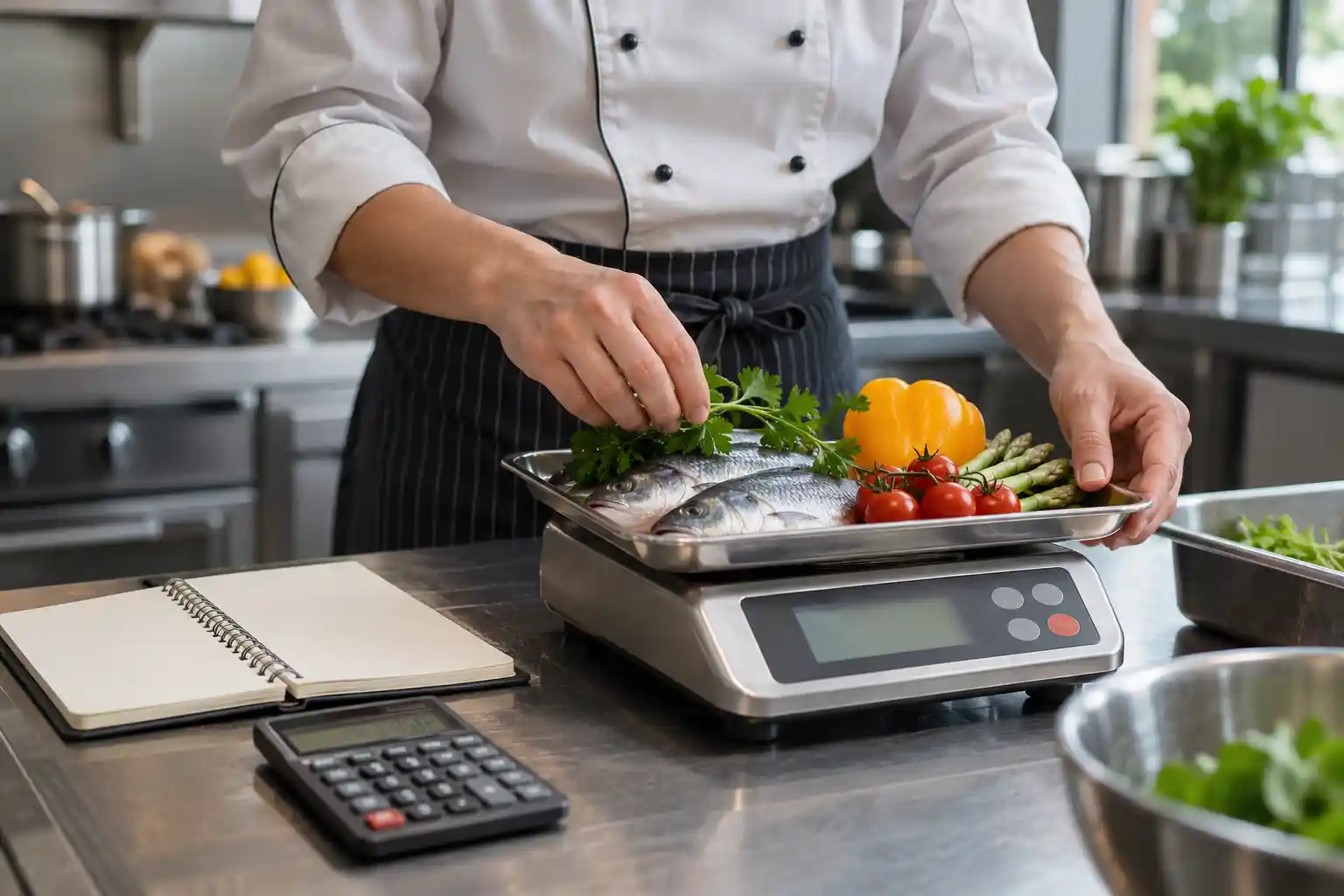
A recipe costing sheet lists, ingredient by ingredient, how much you buy, how much you can use and what it costs. It helps you set prices, compare dishes on your menu and spot when a supplier increase wipes out your margin.
It goes hand in hand with the food cost percentage: the share of the menu price that goes to ingredients. The formula is simple: food cost % = ingredient cost / menu price x 100.
Yield loss tells you how much raw product to buy to serve one trimmed portion. To serve 150 g of usable product with a 25% loss, you need 200 g as purchased (150 / 0.75).
Want to learn to manage costs and margins as part of your career?
Explore the Masters in Culinary Arts at GASMA.
Picture hake in green sauce. The purchase prices are assumed, only to illustrate the calculation, for one portion:
The cost per portion adds up to EUR 3.88. With a 30% target food cost, the menu price before tax is 3.88 / 0.30 = EUR 12.93. In Spain, restaurants then add VAT, which stands at 10% for hospitality at the time of writing, bringing the price to about EUR 14.22. Always check the current rate in your own country.
Cost the recipe without tax and add the tax at the end.
There is no single right figure. Guía Repsol, a Spanish food and hospitality publication, puts 25% to 35% as the range generally considered optimal for most restaurants, and notes that fine dining can run higher and a tapas bar lower. It is a rough benchmark, not a rule.
Your target depends on your concept, your labor costs and your rent, which an ingredient-only costing sheet does not capture. Review your sheets when a key purchase price changes, when you switch supplier and when you redesign the menu.
percentage.
A good costing sheet is a living tool, not a document you write once.
Recipe costing calculates the cost of one specific dish. Food cost expresses that cost as a percentage of the menu price.
When a key purchase price changes or you switch supplier, when you redesign the menu and at least every quarter. Some guides recommend monthly reviews.
An ingredient-only sheet does not. Some guides add labor and indirect costs as an extra percentage on top of the ingredient cost.
Not to begin with. A spreadsheet is enough. Software helps when you have many recipes and prices that change often.
Knowing how to cost a recipe separates the person who cooks well from the one who also runs a profitable business. GASMA is the Gastronomic Campus of CEU Cardenal Herrera University in Castellón, Spain, and trains students in gastronomy and management. The Bachelor’s Degree in Gastronomy curriculum includes Cost Control Applied to Gastronomy in the third year, alongside administration, accounting and entrepreneurship.
Bachelor’s Degree in Gastronomy | Masters in Culinary Arts | Request information