


Understanding the physical, chemical and sensory composition of ingredients is essential to develop a solid technical foundation. Throughout this module, students will study how food components interact, the role of macronutrients and the behaviour of raw materials during culinary processes, applying this knowledge to improve textures, flavours and results in professional cooking.
In-depth knowledge of raw ingredients is essential for any chef. The main product groups (vegetables, poultry, meats, game, fish and seafood) are analysed in terms of their organoleptic characteristics, quality and culinary applications, together with the basic principles of handling, cutting and product utilisation.
Traditional culinary techniques and their evolution form the foundation of modern professional cooking. Core processes such as pickling, curing, marinating, stocks, juices and glazes are explored, alongside the gastronomic use of olive oil and the tradition of Mediterranean rice dishes, applied within a contemporary, product-led cuisine.
Advanced tools and techniques open new creative possibilities in haute cuisine. Processes such as sous-vide cooking, the use of the siphon, texturisers, liquid nitrogen and enzyme applications are introduced, together with the machinery and equipment found in next-generation professional kitchens.
Your passion and your talent deserve the best system to develop, and that is precisely what we offer you: a learning model that transcends conventional classrooms.
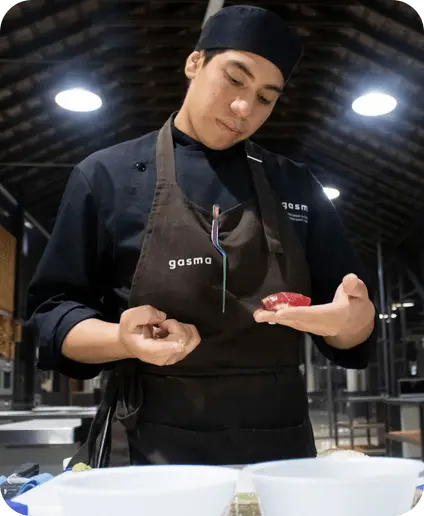
In our Gastronomic Techniques Diploma, we embrace the "learning by doing" methodology with which theory comes to life through your hands and senses, turning each lesson into a unique opportunity to explore, experiment and create.
Imagine an environment where ingredients, pots and pans become tools of expression. In each class, you'll be immersed in the action; from mastering precise cuts to creating signature dishes that stir emotions. Every seasoning, every texture and every presentation will be the palpable result of your effort and dedication.
You will learn as you create, honing your skills in real time. What better way to internalize culinary techniques than by putting them into direct practice?
The "learning by doing" methodology not only accelerates your learning, but also cultivates self-confidence. It's not just about listening and remembering, it's about experimenting and creating.
If you are looking for an eminently practical training that will help you unlock your full gastronomic potential, you are in the right place: join us and start creating your own culinary stories from day one!

Understanding the physical, chemical and sensory composition of ingredients is essential to develop a solid technical foundation. Throughout this module, students will study how food components interact, the role of macronutrients and the behaviour of raw materials during culinary processes, applying this knowledge to improve textures, flavours and results in professional cooking.
In-depth knowledge of raw ingredients is essential for any chef. The main product groups (vegetables, poultry, meats, game, fish and seafood) are analysed in terms of their organoleptic characteristics, quality and culinary applications, together with the basic principles of handling, cutting and product utilisation.
Traditional culinary techniques and their evolution form the foundation of modern professional cooking. Core processes such as pickling, curing, marinating, stocks, juices and glazes are explored, alongside the gastronomic use of olive oil and the tradition of Mediterranean rice dishes, applied within a contemporary, product-led cuisine.
Advanced tools and techniques open new creative possibilities in haute cuisine. Processes such as sous-vide cooking, the use of the siphon, texturisers, liquid nitrogen and enzyme applications are introduced, together with the machinery and equipment found in next-generation professional kitchens.
The world’s great culinary traditions offer a constant source of inspiration and learning. Ingredients, techniques and representative dishes from cuisines such as Japanese, Peruvian, Indian, Mexican, Italian and French are studied, understanding their influence on contemporary gastronomy.
Spanish gastronomy stands out for the diversity of its products, regions and culinary models. Representative approaches such as coastal cuisine, rural cooking and Mediterranean haute cuisine are analysed, together with the role of products with protected designation of origin and an introduction to the world of wine and beverage pairing.
The Diploma's Final Project will allow you to put into practice all the knowledge acquired by presenting a personal gastronomic proposal, adapted to current market trends. This project is an exercise of integration of all the contents received.
Improve your training in restaurants and gastronomic businesses of national and international prestige, and increase your job opportunities. Learn from the best professionals and work in a team at the highest level.
Do your internship at Michelin, Repsol and 50 Best restaurants, and live the experience of working as part of a staff of chefs or pastry chefs in a high-level restaurant.
Learn the working methods and facilities that convey the culinary concept of the restaurant.
Cook alongside world-renowned chefs to enhance your resume and immerse yourself in haute cuisine on a global level.
Your passion and your talent deserve the best system to develop, and that is precisely what we offer you: a learning model that transcends conventional classrooms.
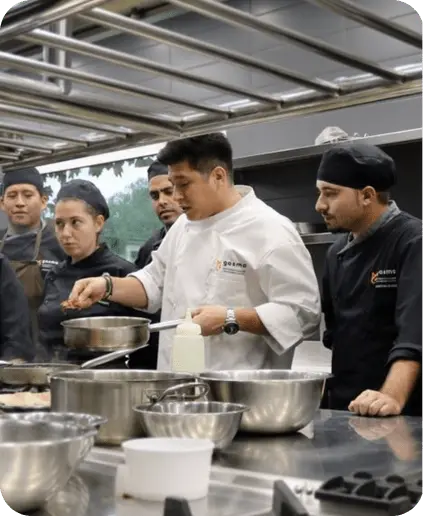
In our Diploma in Chef de Cuisine, we embrace the "learning by doing" methodology whereby theory comes to life through your hands and senses, turning each lesson into a unique opportunity to explore, experiment and create.
Imagine an environment where ingredients, pots and pans become tools of expression. In each class, you'll be immersed in the action; from mastering precise cuts to creating signature dishes that stir emotions. Every seasoning, every texture and every presentation will be the palpable result of your effort and dedication.
You will learn as you create, honing your skills in real time. What better way to internalize culinary techniques than by putting them into direct practice?
The "learning by doing" methodology not only accelerates your learning, but also cultivates self-confidence. It's not just about listening and remembering, it's about experimenting and creating.
If you are looking for an eminently practical training that will help you unlock your full gastronomic potential, you are in the right place: join us and start creating your own culinary stories from day one!
Understanding the physical, chemical and sensory composition of ingredients is essential to develop a solid technical foundation. Throughout this module, students will study how food components interact, the role of macronutrients and the behaviour of raw materials during culinary processes, applying this knowledge to improve textures, flavours and results in professional cooking.
In-depth knowledge of raw ingredients is essential for any chef. The main product groups (vegetables, poultry, meats, game, fish and seafood) are analysed in terms of their organoleptic characteristics, quality and culinary applications, together with the basic principles of handling, cutting and product utilisation.
Traditional culinary techniques and their evolution form the foundation of modern professional cooking. Core processes such as pickling, curing, marinating, stocks, juices and glazes are explored, alongside the gastronomic use of olive oil and the tradition of Mediterranean rice dishes, applied within a contemporary, product-led cuisine.
Advanced tools and techniques open new creative possibilities in haute cuisine. Processes such as sous-vide cooking, the use of the siphon, texturisers, liquid nitrogen and enzyme applications are introduced, together with the machinery and equipment found in next-generation professional kitchens.
The world’s great culinary traditions offer a constant source of inspiration and learning. Ingredients, techniques and representative dishes from cuisines such as Japanese, Peruvian, Indian, Mexican, Italian and French are studied, understanding their influence on contemporary gastronomy.
Spanish gastronomy stands out for the diversity of its products, regions and culinary models. Representative approaches such as coastal cuisine, rural cooking and Mediterranean haute cuisine are analysed, together with the role of products with protected designation of origin and an introduction to the world of wine and beverage pairing.
The Diploma's Final Project will allow you to put into practice all the knowledge acquired by presenting a personal gastronomic proposal, adapted to current market trends. This project is an exercise of integration of all the contents received.
Improve your training in restaurants and gastronomic businesses of national and international prestige, and increase your job opportunities. Learn from the best professionals and work in a team at the highest level.
Do your internship at Michelin, Repsol and 50 Best restaurants, and live the experience of working as part of a staff of chefs or pastry chefs in a high-level restaurant.
Learn the working methods and facilities that convey the culinary concept of the restaurant.
Cook alongside world-renowned chefs to enhance your resume and immerse yourself in haute cuisine on a global level.
Your passion and your talent deserve the best system to develop, and that is precisely what we offer you: a learning model that transcends conventional classrooms.
In our Diploma in Chef de Cuisine, we embrace the "learning by doing" methodology whereby theory comes to life through your hands and senses, turning each lesson into a unique opportunity to explore, experiment and create.
Imagine an environment where ingredients, pots and pans become tools of expression. In each class, you'll be immersed in the action; from mastering precise cuts to creating signature dishes that stir emotions. Every seasoning, every texture and every presentation will be the palpable result of your effort and dedication.
You will learn as you create, honing your skills in real time. What better way to internalize culinary techniques than by putting them into direct practice?
The "learning by doing" methodology not only accelerates your learning, but also cultivates self-confidence. It's not just about listening and remembering, it's about experimenting and creating.
If you are looking for an eminently practical training that will help you unlock your full gastronomic potential, you are in the right place: join us and start creating your own culinary stories from day one!

Next call: September 2026. Fees are currently being updated for the next edition.
Classes: Information will be available soon
Format: On-site
Located: Castellón, Spain (see location)
Language: Spanish. Simultaneous translation into English.
Credits: 16 ECTS (Credit system)
Extras included in the registration fee:
If you already know that you want to study with us, enrolling in our training is very easy.
You must fill in the admission form that you can find in the button 'START ENROLLMENT'.
You will then receive an email confirming receipt of your application and we will contact you via email / call / whatsapp to move on to the next phase of the process: the interview with the Admissions Committee.
Within 24 hours of receiving your application, you will be scheduled for a personal interview* with a member of the Gasma faculty or admissions team.
The purpose of the interview is to get to know the candidates, and to assess their knowledge of the industry and their aptitude for the program.
In this interview, we will let you know if you need to provide any additional documents to complete your application.
* If you are unable to attend in person, the interview can also be conducted via Skype.
After the personal interview, the Admissions Committee will evaluate your application.
Once your application has been evaluated, we will inform you of the result.
If you have been accepted... Congratulations! The admission process has been completed.
In order to secure your place, it is necessary to formalize the payment of the reservation.
Once the place reservation is paid, we will review with you again the necessary documentation for your enrollment. Remember that you must have sent us the following information: ID/Passport, Resume or Letter of motivation and required academic documentation (if necessary).
Gasma is located in Castellón de la Plana (Valencian Community), Spain. The nearest airport is Valencia International Airport (70 km away). Our city is 2 hours by train from Barcelona and just under 3 hours from the capital of Spain, Madrid.
Gasma - Gastronomic Campus
Avenida Enrique Gimeno, 67
12006 Castellón, Spain, EU
Tel: +34 964 217 649
Our international student body continues to grow. We have students of more than 75 nationalities. European students do not need a visa to study in Spain. On the other hand, non-European students must obtain the corresponding visa that includes the authorization to stay in the country.
Students from certain countries are exempt from obtaining a visa as long as their stay in Spain does not exceed three months.
The visa will be requested and issued at the Spanish Consular Offices abroad. Once in Spain, Gasma offers non-EU students the optional International Fee service: with it, they can apply for the foreign student card through the Immigration Office or the corresponding police station within one month of their arrival.
To make your stay easier and more comfortable during your studies, Gasma has agreements with various organizations to provide our students with accommodation options nearby. In advance of your arrival you will be able to choose and reserve your accommodation in an apartment, student residence, etc. Contact our admissions department to clarify any doubts regarding this issue.
